Printing technology: offset, digital and screen printing. What are the differences?
Offset printing
Offset printing is the most popular printing method, with large print runs. It has several advantages:
- Good print quality;
- The ability to print on any type of paper, with the possibility of using post-printing;
- Printing large print runs in a short time;
- Significant reduction in the cost of printing for large runs.
- A high degree of standardization and automation of the entire production process.
It also has several disadvantages:
- It requires layout fitting and prepress processing (color separation, color proof, form creation, form printing, press preparation, color balance), which can take a long amount of time.
- Printing small runs unprofitable, due to the long prepress processing;
- There is no possibility to print unique data, but this disadvantage is filled by the possibility of post-printing processing of the circulation. To print unique information, the result of offset printing can be driven through a digital printing machine;
- Difficult to print on non-standard materials.
Offset printing is of two types: traditional and dry. They differ in the method of repulsion of paint from the printing form.
Two shafts are involved in offset printing: a shaft with a shape and an offset shaft, as well as oil paint. In the case of traditional offset printing, a water-alcohol mixture (moisturizing solution) is also involved.
The principle of offset printing is as follows: the ink from the printing form is transferred first to an elastic intermediate carrier - usually a rubber cloth, and then to printed material. In traditional offset printing, in order not to seal the empty areas of the printing form, on which paint is not needed, a moisturizing solution is applied to them, which repels oil paint. In dry offset printing, the shaft itself is coated with paint-resistant silicone material and the top layer is removed from the required places for printing.
Scheme tier traditional offset:
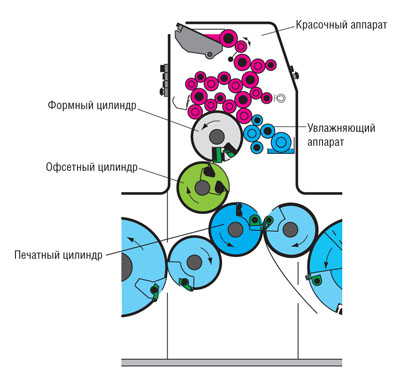
Simplified offset printing scheme:
Digital printing
Digital printing is called inkjet printing, laser printers, industrial sheet and roll printing machines, large format plotters and other types of equipment that allow you to play the image and text from an electronic file, bypassing the process of applying the image on the offset forms. Pre-press preparation in the digital method is limited only to working with colors, marking and layout of the layout on the printed sheet. The advantages of such printing:
- Efficiency (you can start printing immediately, without wasting time on molding processes);
- Absence of expenses for prepress preparation (conclusion of plates);
- The relative cheapness of printing for small runs;
- The ability to print on non-standard materials such as fabric, canvas, film, ceramics;
- Flexibility in correcting the already started printing process;
- No large area is required for equipment installation;
- High speed to get the finished edition.
Disadvantages of digital printing:
- Restriction in use for printing Pantone colors;
- Problems with the uniformity of paint on large monochromatic dies;
- Unreliable connection of paint and paper: on the folds, when printing leaflets toner on the plate will crack;
- Lower quality of color rendition compared to offset;
- The high cost of consumables (medium and large print runs more profitable to print on offset).

Industrial digital printing machines differ from printers in the format of the printed material and printing speed; devices that can output from 70 pages per minute are considered industrial.
Special coated and uncoated papers and cardboards, self-adhesive materials (both on the basis of paper and on the basis of polymers) are made for digital printing, also use designer papers, including various spraying, textures, and other effects. The material for digital printing should be distinguished by a high degree of smoothness and even edges of the crop.
Screen printing (silk-screen printing)
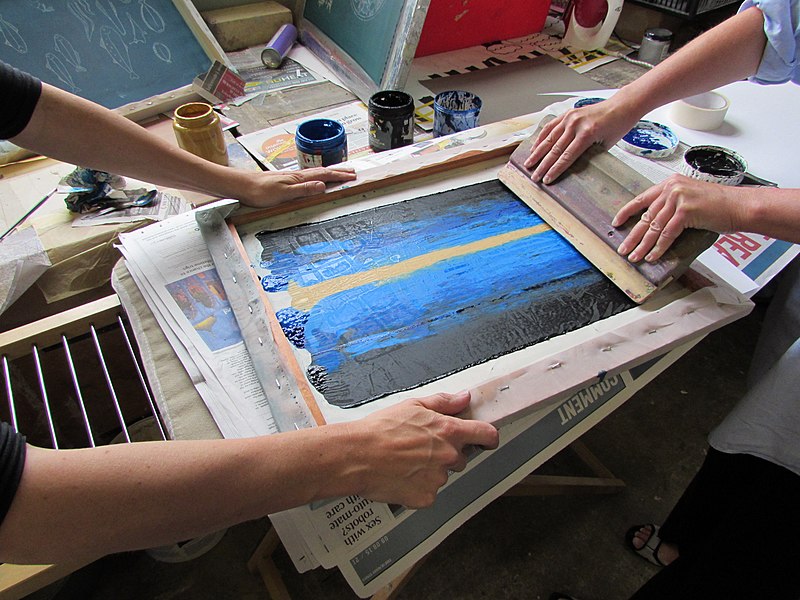
In screen printing, the print is obtained by forcing paint through the printing form. A stencil is used as a printing form, which is a frame with a fine grid stretched inside, and an image template. The mesh, most often, is made of synthetic material or metal threads, less often of natural silk. Through the open mesh cells, the ink is applied to the material to be printed. The second name, silk-screen printing, was obtained thanks to silk, which was used at the origin of this printing method.
Advantages of silk-screen printing:
- You can print on a variety of surfaces, such as plastic, paper, glass, metal, fabric, and even electronics;
- Allows you to seal uneven surfaces;
- High-quality image transfer;
- Low cost when printing small runs;
- Allows the use of ink, the use of which is difficult for digital printing, for example, metalized (gold, silver);
- Large thickness and stability of the paint layer.
The disadvantages of silk screen printing:
- Poor performance.
Silk-screen printing is often used in the production of representative printing products with a small circulation: printing of business cards, postcards, folders, invitations, booklets and other things from 50 copies. For large print runs, printing with the use of Pantone inks and non-standard gold and silver prints, it is more economical to implement in an offset way.
The printing and quality properties of the stencil grid are determined by the print material, its linear pattern (the number of grid threads per centimeter of its length) the stencil thickness, the degree of grid openness — the ratio of the total area of all cells to the total area of the grid in percent. In screen printing, you can use a grid with a lineature from 10 to 200 threads/cm. The most commonly used nets contain from 90 to 120 threads/cm. The thickness of the paint layer depends on the thickness of the threads and the distance between them. The image pattern is placed on the side of the mesh opposite to that on which the squeegee moves, in order to avoid damage and wear.
The image can be formed on the grid in several ways:
- With the direct method, copying solution is applied to the net and dried, forming a photosensitive soluble copying layer. An image is displayed on it, with the gap areas hardening, and the printers are subsequently washed out with water.
- With the indirect method, the image is applied to a special film material with a copy layer. A copy of the image is being processed, whitespace elements are hardening. Then the copy rolls over to the grid.
- The combined method is a combination of the two above. The image is applied on the grid, previously connected to the copying material and copying solution. This allows you to create more repetitive forms and achieve high-definition printing.
- In the digital method, the photosensitive layer is applied to the grid, an image is recorded on it with a laser beam, followed by a manifestation of form.
Printing products stencil process is carried out both manually and through special printing machines. This happens as follows: the printing form is installed on the form-holder. The sealed material is installed in a horizontal position, its immobility is provided by stops and vacuum. The paint is applied to the mold, then the squeegee is pressed into the mesh, while the squeegee presses the mesh and simultaneously cuts off the remaining paint. The mold is then retracted, and the sealed material is removed to dry.